Alert · AnswerAlert
This tool on every surface: CLI · MCP · Python · JavaScript · Go · Java · .NET
Read a system dialog, or answer it with accept or dismiss. These call app_alert.
Alert
public string Alert()
What a system dialog says, or an empty string when none is up. A permission prompt is another process's window, not the app's, and reading it needs no knowledge of what the buttons say.
AnswerAlert
public void AnswerAlert(bool accept)
public void AnswerAlert(bool accept, string text)
Accepts or dismisses a system dialog. These answer a dialog; they do not choose an outcome. On a permission prompt they do not mean grant and deny, and on iOS they are the other way round — accept leaves it denied and dismiss leaves it granted, because W3C accept presses the affirmative button and Apple puts "Don't Allow" last. Tap the button by ref for a particular answer.
Types into a dialog's field, then accepts or dismisses it, in one
call. A plain alert has no field, and the platform refuses the
text. What accept and dismiss press is as for
AnswerAlert(bool).
Examples
Ask whether a system dialog is up, and what it says
var text = device.Alert(); // empty when no dialog is up
if (text != "") Console.WriteLine(text);
The same call from the command line, mobium alert, printed on an Android 15 emulator:
a dialog is on screen: "Discard changes?\nThey will be lost."
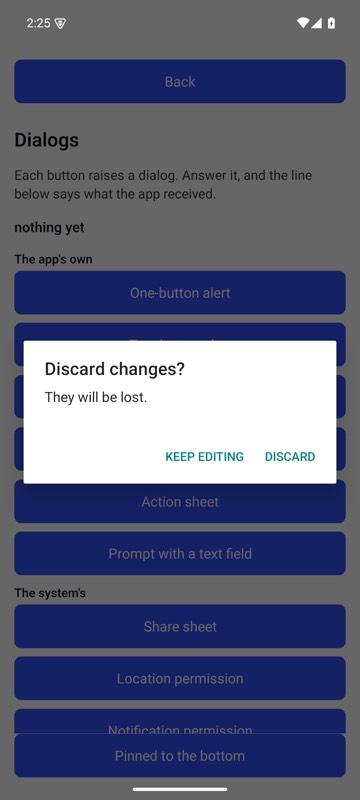
mobium alert on an Android 15 emulator
Answer it with the platform's accept button
device.AnswerAlert(true);
The same call from the command line, mobium alert accept, printed on an Android 15 emulator:
accepted the dialog "Discard changes?\nThey will be lost." — this answered it and did not choose an outcome: on a permission prompt accept and dismiss do not mean grant and deny, and on iOS they are the other way round. Tap the button by ref if you need a particular answer
| Before | After |
|---|---|
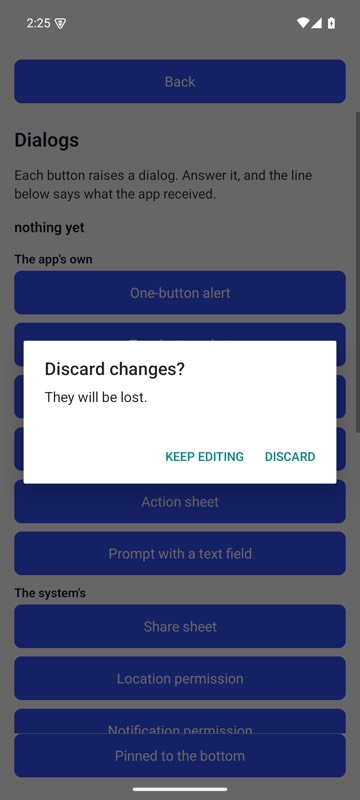 | 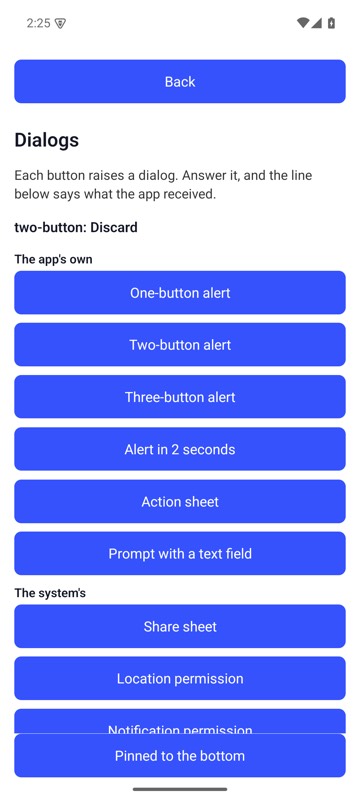 |
mobium alert accept on an Android 15 emulator
More examples
Fill a prompt's field and accept it, in one call
device.AnswerAlert(true, "Groceries");