add_dialog_rule · dialog_rules · clear_dialog_rules
This tool on every surface: CLI · MCP · Python · JavaScript · Go · Java · .NET
Declare how to answer a dialog, so an action that meets it carries on: when a dialog whose text contains when is in the way of a tap, a type or any action with a target, the button captioned press is pressed, the dialog is confirmed gone, and the action continues — and its result says which dialog was answered. These call app_dialogs.
add_dialog_rule
def add_dialog_rule(when: str, press: str) -> None
Declare how to answer a dialog, so an action that meets it carries on:
when a dialog whose text contains when is in the way, press the
button captioned press. It names a button, not accept or dismiss,
because which button those press differs by platform and by dialog.
Captions match ignoring case.
dialog_rules
def dialog_rules() -> list
The declared rules, each with how often it has answered.
clear_dialog_rules
def clear_dialog_rules() -> None
Remove every rule for this device.
Examples
Answer a dialog whenever it gets in the way
device.add_dialog_rule(when="Save password", press="Not now")
The same call from the command line, mobium dialogs --when "Save password" --press "Not now", printed on an Android 15 emulator:
1 dialog rule(s)
  when "Save password": press "Not now"  (answered 0)
Remove every rule
device.clear_dialog_rules()
The same call from the command line, mobium dialogs --clear, printed on an Android 15 emulator:
no dialog rules
On a device
| Before | After |
|---|---|
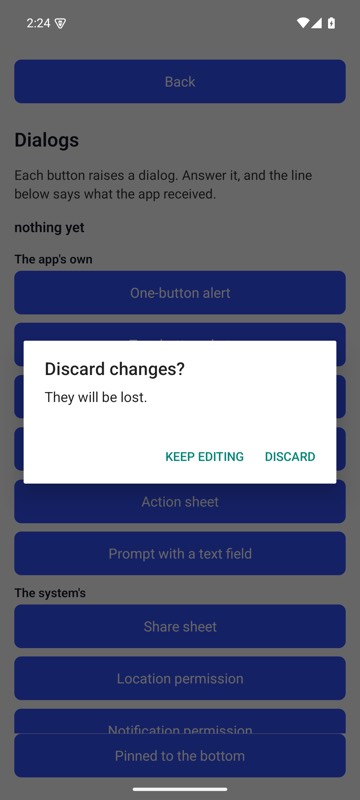 | 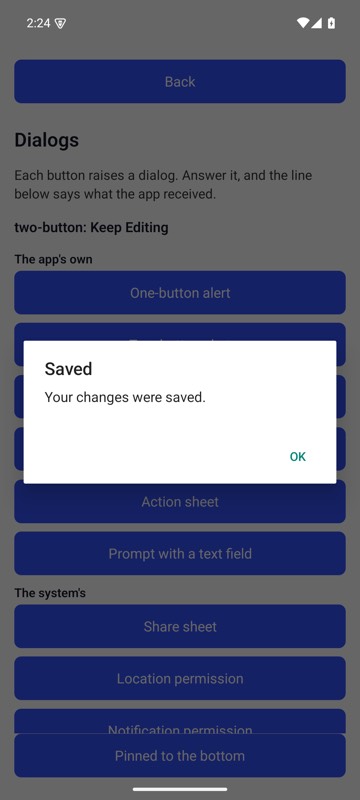 |
With mobium dialogs --when "Discard changes" --press "Keep Editing" declared, mobium tap testid=oneButtonBtn met the Discard dialog in its way, pressed Keep Editing, and went on — its own alert is up, and the line under the title says what the app received — on an Android 15 emulator